


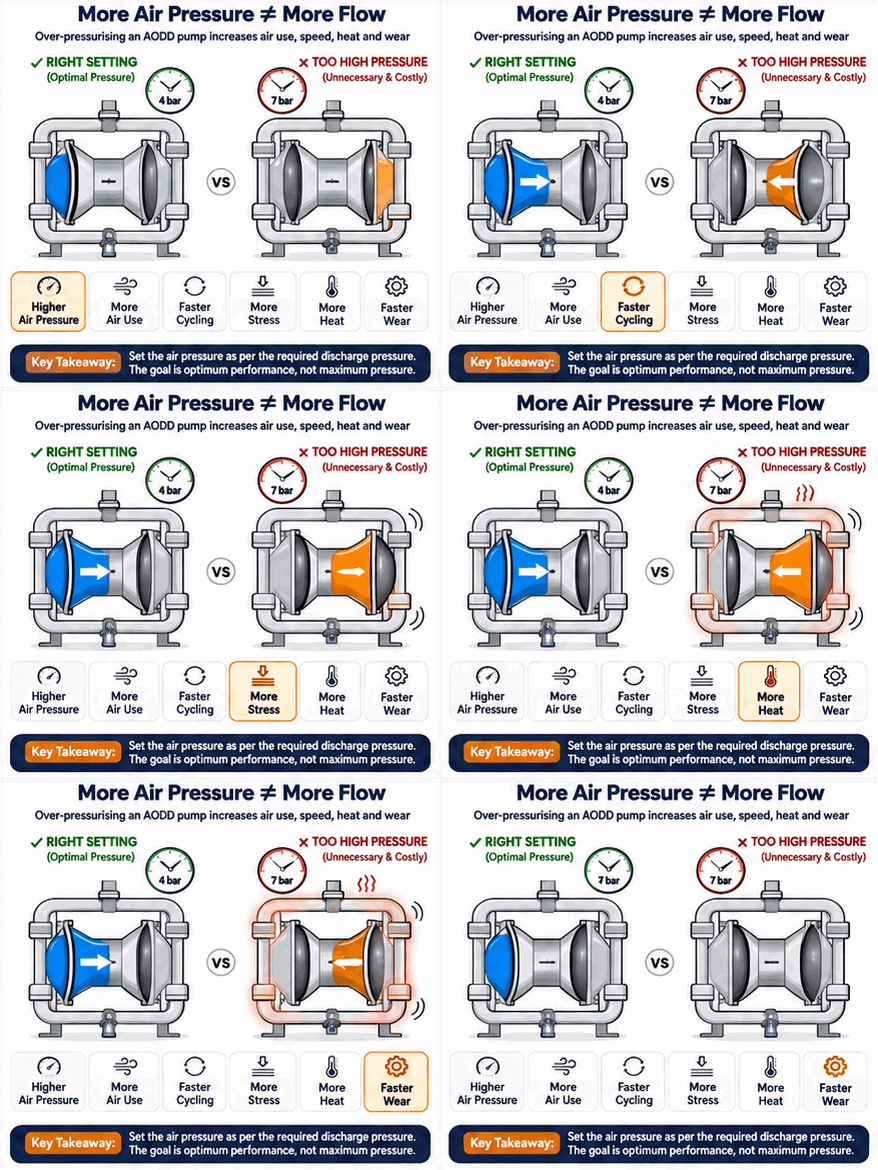
Ask around a plant floor and you will hear the same instinct again and again: the pump isn't delivering enough, so turn the air regulator up. It feels logical. More energy in, more performance out. But with an Air Operated Double Diaphragm (AODD) pump, that instinct is one of the most common — and most expensive — misconceptions in day-to-day operation. This is what actually happens when the regulator goes up.
An AODD pump runs on compressed air that alternately pushes each of its two diaphragms. Because the air side and the liquid side work on a 1:1 pressure ratio, the air inlet pressure only has to be high enough to overcome the discharge pressure and the resistance in the system. Pushing it well past that point does not unlock a proportional amount of extra flow.
What it does do is increase air consumption, accelerate the operating cycle and put additional stress on the pump's moving parts. The result is a pump that costs more to run and wears out sooner — often without delivering the improvement the operator was hoping for.
Turning up the regulator sets off a chain of effects, each one feeding the next. Here is the sequence from the first adjustment to the final bill.
It usually begins at the air regulator. Flow looks a little low, the process is waiting, and someone turns the dial up — assuming that it will improve discharge performance.
Sometimes the pump does speed up a little. But flow in an AODD pump is governed by more than the regulator setting: the air supply volume, the discharge head, the suction conditions, the fluid viscosity and the size of the pump all play a part. If the real bottleneck is any of those, a higher regulator setting simply adds pressure without removing the bottleneck.
Compressed air is not free. Every AODD pump is a consumer of it, and a higher operating pressure can raise the compressed air demand of the pump — which directly raises energy costs.
In a plant running several pumps, that adds up quickly. Air that is being used to over-drive one pump is air that is not available to the others, and the compressor works harder to keep up.
Depending on system resistance, a pump supplied with more air pressure may run at a higher cycling rate. Each cycle is one complete pass of the diaphragms, the air valve and the check valves.
A faster cycling rate looks like better performance from the outside — the pump sounds busier. But it also means every moving part is doing more work for the same amount of liquid moved, which is exactly where the next two effects come from.
The diaphragm is the part of an AODD pump that flexes every cycle, and flexing is what eventually fatigues any elastomer or PTFE membrane. More frequent diaphragm flexing increases the number of operating cycles it goes through each day, and that can accelerate fatigue.
Higher pressure also loads the manifold bolting, the diaphragm clamping area and the air distribution components harder than the design intended for normal duty. This is one more reason correct installation and operation practice matters as much as pump quality.
Diaphragms, air distribution components and other moving parts may experience increased wear, depending on the operating conditions. Seats, balls and the air valve all move with every cycle, and more cycles means a shorter service interval.
Put the five effects above together and the total cost of operation rises: more compressed air, unnecessary cycling, more frequent maintenance and more spares. The pump that was "turned up for performance" ends up being the most expensive pump on the line to keep running.
It is the same principle behind preventive pump maintenance — the cheapest repair is the one you never have to make.
The objective isn't to run an AODD pump at maximum air pressure. It's to operate it at the optimum pressure for the application. In practice, that comes down to five habits:
Tell us your fluid, flow rate, discharge head and available air supply — our engineers will recommend the right pump size and operating pressure.
Get a Free Quote Call +91 9819395995Not necessarily. Flow depends on the air supply volume (SCFM), the discharge head, the system resistance and the pump size. Raising the regulator setting beyond what the application needs mainly increases air consumption, cycling rate and wear, rather than delivering proportionally more flow.
Set the air pressure according to the required discharge pressure of your application, and never exceed the manufacturer's rated maximum air pressure. Because AODD pumps work on a 1:1 air-to-liquid pressure ratio, the air inlet pressure only needs to be high enough to overcome the discharge head and system resistance.
Higher air pressure can make the pump cycle faster, which means the diaphragms flex more often and accumulate fatigue sooner. Diaphragms, the air distribution system and other moving parts can wear faster, and compressed air consumption rises, increasing operating cost.
Both matter. Air pressure must match the required discharge pressure, while the air supply must also deliver adequate volume (SCFM). An undersized air line or compressor can starve the pump even when the regulator reads the correct pressure.
Check that the pump is correctly sized for the required flow and head, ensure the air line and fittings provide enough air volume, reduce restrictions in the suction and discharge piping, and consult the pump's performance curve. If the flow requirement is still not met, a larger pump is usually the right answer.