


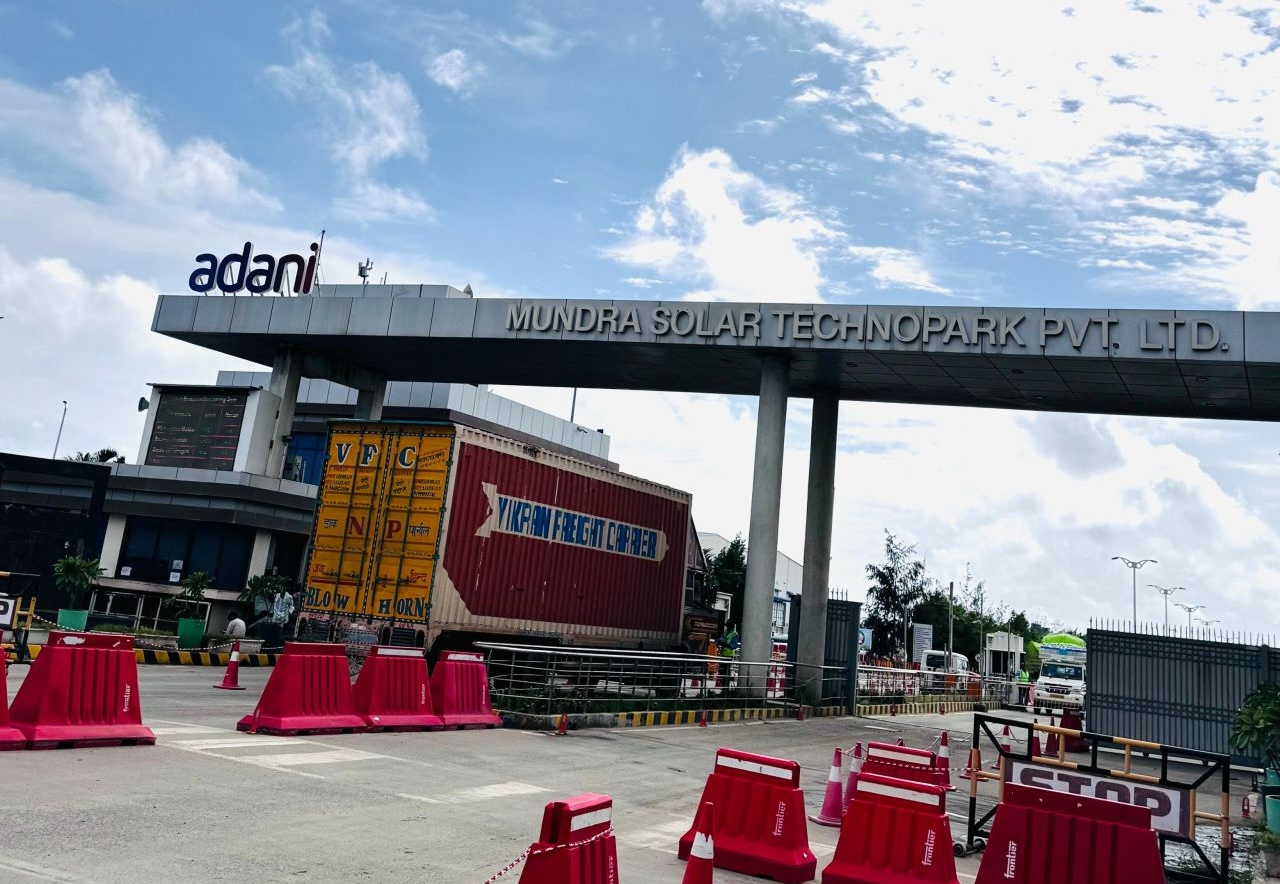
Mundra Solar Technopark Pvt. Ltd. (Adani Solar), Kutch, Gujarat — Antlia Engineering Works field visit, 22nd August 2025
On 22nd August 2025, the Antlia Engineering Works team visited the Adani Solar plant at Mundra, Kutch, Gujarat to work directly with their operations team on improving AODD pump performance for critical chemical transfer — including KOH, H₂O₂, HF, HCl, and O₃. This field report documents our on-site observations and the practical solutions recommended to improve pump uptime, diaphragm life, and process output consistency.
The facility uses YTS-make 1-inch AODD pumps across three materials of construction for acid and alkaline chemical transfer:
| Pump Body MOC | Diaphragm Fitted | Backup Diaphragm |
|---|---|---|
| PP (Polypropylene) | TPO (Thermoplastic Polyolefin) | — |
| PVDF (Polyvinylidene Fluoride) | TPO (Thermoplastic Polyolefin) | — |
| SS-316 (Stainless Steel) | PTFE (Main diaphragm) | Neoprene backup — MISSING |
Operation cycles: Rinsing — 24 hours continuous | Acid transfer — 6–8 hours per cycle
The SS-316 pumps were running PTFE main diaphragms without neoprene backup diaphragms. Since PTFE lacks the elasticity of rubber, it flexes unevenly under cyclic air pressure — causing premature fatigue cracking and significantly shortened diaphragm life.
As an immediate support measure, Antlia will supply 2 pcs PTFE + 2 pcs rubber diaphragms for the SS-316 pumps for field testing — dispatch within 10–12 days (dye-making in process).
Several pumps were mounted with excessively tight bolting to their support frames. Over-tightened mounting transmits the reciprocating vibration directly into the pump body and piping — creating back pressure spikes and mechanical stress that accelerates diaphragm failure.
| Parameter | Value |
|---|---|
| Perceived output | 100–120 LPM |
| Actual measured output | 40–50 LPM |
| Output drop | ~50–60% |
The piping system includes approximately 30–40 m horizontal + 10 m vertical + 5–7 bends, resulting in 20–25 m total head loss (~2.5 kg pressure drop). The piping also includes reducers stepping from a 1.5-inch main line to 1-inch pump connections — adding further restriction.
AODD pumps operate at a 1:1 air-to-liquid pressure ratio — the discharge pressure can never exceed the inlet air pressure. The pressure audit revealed significant losses:
| Air Pressure Point | Pressure (kg/cm²) |
|---|---|
| Available at compressor | 6 kg/cm² |
| Running pressure at pump | 5 kg/cm² |
| Lost to piping head & friction | 2.5 kg/cm² |
| Net effective discharge pressure | ~2.5 kg/cm² |
With 2.5 kg lost to the piping system, the effective discharge pressure drops proportionally — directly explaining the output shortfall observed at the pump outlets.
Delays in procuring consumables — O-rings, gaskets, U-cups, seals, valve balls, valve seats, ball cages, and diaphragms — were causing unplanned downtime at the facility.
| Spare Part | MOQ |
|---|---|
| O-Rings & Seals | 20 pcs per item |
| Valve Seat & Ball Cage | 8 pcs per item |
| Diaphragms | 10 pcs per item |
| Valve Balls | 10 pcs per item |
Implementing the above recommendations will deliver:
Our engineers at Antlia Engineering Works, Mumbai provide on-site visits, pump selection, and after-sales technical support across India.
Get in Touch Call +91 9819395995PTFE has very low elasticity. Without a rubber backup diaphragm to support and distribute cyclic flexing stress, PTFE fatigue-cracks rapidly under reciprocating air pressure. A neoprene backup acts as a cushion and structural support — extending PTFE diaphragm life to 12–18 months.
AODD pumps operate at a 1:1 air-to-liquid pressure ratio. Long horizontal runs, vertical lifts, and pipe bends create frictional head losses that reduce net discharge pressure. At this site, approximately 2.5 kg pressure was lost to the piping system, reducing output from 100–120 LPM to only 40–50 LPM. Upgrading to a 1.5-inch pump compensates for these losses.
Over-tightened pump mounting transmits the reciprocating vibration directly into the frame, piping, and pump body — causing mechanical stress on diaphragms and connections. The solution is to loosen mounting hardware slightly and install rubber anti-vibration pads or legs under the pump base.
PVDF body with PTFE main diaphragm and neoprene backup is the recommended configuration for HF, HCl, KOH, H₂O₂, and O₃ service. PVDF offers superior resistance to fluorinated and chlorinated compounds, while PTFE provides the broadest wetted-part chemical compatibility.
For 24-hour continuous rinsing and 6–8 hour acid transfer cycles, maintain buffer stock per the MOQ plan: 20 pcs O-rings/seals, 8 pcs valve seats/ball cages, 10 pcs diaphragms, and 10 pcs valve balls per item. Review and replenish quarterly to prevent unplanned downtime.