

Listen to this article
Audio version — Role of Diaphragm in an AODD PumpThe diaphragm plays a critical role in the operation of an Air Operated Double Diaphragm (AODD) pump. AODD pumps use two flexible diaphragms connected by a shaft that move back and forth to create suction and discharge pressure. The diaphragm is effectively the heart of the pump — without it, the pump cannot function. Here are the key functions of the diaphragm in an AODD pump.
The diaphragm separates the fluid being pumped from the compressed air used to operate the pump. This prevents the fluid from coming into contact with the air and helps maintain the purity of the fluid — critical for chemical, pharmaceutical, and food applications.
The diaphragm is made of a flexible material — rubber or elastomer — which allows it to move back and forth as it is alternately compressed and released by compressed air. This flexibility also enables it to handle viscous and abrasive fluids without damage.
The diaphragm creates a seal between the suction and discharge sides of the pump. As it moves back and forth, it creates suction on one side and discharge pressure on the other — which moves the fluid through the pump continuously.
The diaphragm is designed to withstand the stresses of repeated flexing and exposure to various fluids and chemicals. High-quality materials and careful design ensure long service life even in demanding industrial applications.
One of the most important roles of the diaphragm is to act as a barrier between the pumped fluid and the compressed air. In an AODD pump, air and liquid occupy separate chambers — separated entirely by the diaphragm.
This complete separation means the pumped fluid never contacts the air supply, which is essential in applications where contamination is not acceptable — such as pharmaceutical manufacturing, food processing, and chemical transfer.
The two diaphragms in an AODD pump are connected by a central shaft. When compressed air pushes one diaphragm outward (the discharge stroke), it simultaneously pulls the other diaphragm inward (the suction stroke) — creating a continuous, alternating pumping action.
This flexibility is what allows AODD pumps to handle a wide variety of fluids — including viscous, abrasive, shear-sensitive, and hazardous liquids — that would damage or clog other pump types.
The diaphragm material is one of the most critical selection criteria for an AODD pump. The wrong material can lead to premature failure, fluid contamination, or chemical incompatibility. The five most common diaphragm materials are:
Best for oils, fuels, lubricants, and petroleum-based fluids. Most economical option for general industrial applications. Not suitable for aggressive acids or solvents.
Good resistance to mild chemicals, water, and moderate oils. A general-purpose option for less aggressive applications. Better weather and ozone resistance than Buna-N.
Excellent flexibility and durability across a wide range of chemicals. Most popular general-purpose diaphragm material — good for water, mild acids, and general chemicals.
Superior resistance to solvents, inks, aromatic hydrocarbons, and aggressive chemicals. Ideal for demanding chemical and petrochemical applications.
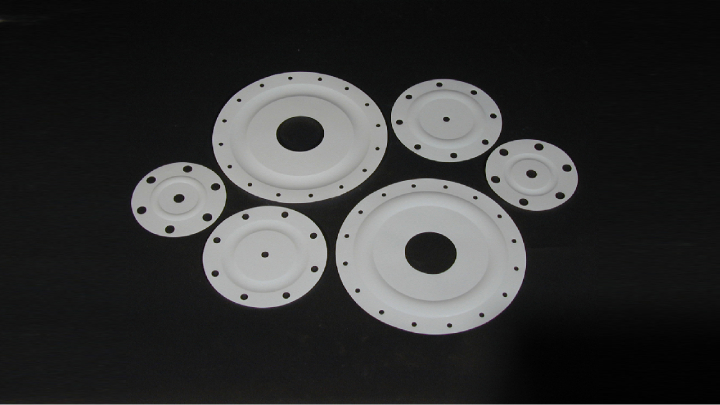
PTFE offers the broadest chemical resistance of all diaphragm materials — suitable for virtually all acids, solvents, and aggressive fluids. FDA compliant for food and pharmaceutical use. Recommended for the most demanding applications.
A well-maintained AODD pump diaphragm can last for years of continuous operation. The diaphragm is designed to withstand repeated flexing — typically millions of cycles — and exposure to various fluids. However, using an incompatible diaphragm material significantly shortens service life.
Overall, the diaphragm is the most critical component of an AODD pump. It plays four key roles: creating suction and discharge pressure, separating the fluid from the compressed air, maintaining the purity and integrity of the pumped fluid, and providing durable performance in demanding industrial conditions.
Selecting the right diaphragm material for your specific fluid and application is essential for long pump life, reliable performance, and safe operation.
Our engineers at Antlia Engineering Works, Mumbai will recommend the best diaphragm material for your fluid and application — free of charge. We also supply genuine spare diaphragms for all Antlia AODD pump models.
Get Free Technical Guidance Call +91 9819395995The diaphragm plays four critical roles: Separation (isolating fluid from compressed air), Flexibility (flexing to create suction and discharge), Sealing (separating suction and discharge sides), and Durability (withstanding repeated flexing and chemical exposure).
The two diaphragms are connected by a shaft. When compressed air pushes one diaphragm outward (discharge stroke), it pulls the other inward (suction stroke), creating a vacuum that draws fluid from the suction line. This alternating action creates continuous pumping flow.
AODD pump diaphragms are available in Buna-N (NBR) for oils, Neoprene for mild chemicals, Santoprene for general purpose, Viton (FKM) for aggressive solvents and chemicals, and PTFE (Teflon) for the widest chemical compatibility and FDA applications.
Replace the diaphragm when you notice chemical leakage from the air exhaust port, visible cracks or deformation, sudden loss of suction or flow, or as part of scheduled preventive maintenance every 3–6 months for critical applications.