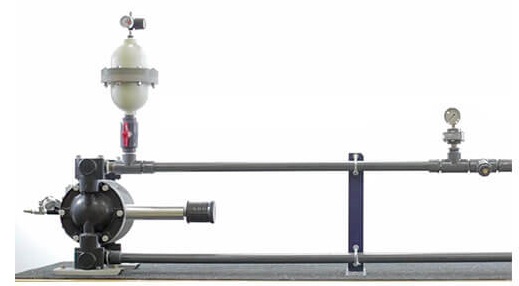
AODD PumpPulsation Dampener April 2026 Antlia Engineering Works
3 FAQs About Pulsation Dampeners for AODD Pumps
Listen to this article
Audio version — 3 FAQs About Pulsation Dampeners
If you have an Air Operated Double Diaphragm (AODD) pump in your system, you may be experiencing pulsation — the characteristic rattling and vibration movement in the pipes caused by the pump's alternating diaphragm action. A pulsation dampener is an effective solution to get a smooth, steady flow from your AODD pump.
80–90%
Pulsation absorbed by dampener
✓
Smooth laminar flow downstream
↓
Pipe stress & vibration reduced
Q1
What Does a Pulsation Dampener Do?
A pulsation dampener absorbs the energy from the pulse waves created by a diaphragm pump — similar to how a shock absorber works in a vehicle. The alternating movement of the two diaphragms creates pressure surges in the discharge line with every stroke. These surges cause pipes to rattle, vibrate, and stress at connection points.
By absorbing these pulse waves, the pulsation dampener:
Protects pipe welds and support brackets from fatigue damage
Reduces vibration and noise in the piping system
Protects downstream flow meters, sensors, and control valves
Prevents hammer effect in long discharge lines
Simple Analogy: Just as a shock absorber in a vehicle absorbs road bumps to give passengers a smooth ride, a pulsation dampener absorbs pump pressure spikes to give the downstream piping a smooth, steady flow.
Q2
How Does a Pulsation Dampener Work?
The pulsation dampener is a pressure vessel installed in the discharge line of the AODD pump. Here is how it works:
The pulsating flow from the pump enters the dampener vessel
An air pocket trapped above the fluid inside the vessel acts as a compressible cushion
When a pressure pulse arrives, the air pocket compresses and absorbs the energy of the pulse wave
When the pressure drops between strokes, the air pocket expands and releases energy — pushing fluid downstream at a steadier rate
This action absorbs 80%–90% of the pulsation, allowing a laminar (smooth) flow to continue downstream of the dampener.
Installation: The pulsation dampener is installed in the discharge line, as close to the pump outlet as possible, for maximum effectiveness. It is typically sized based on the pump's port size and flow rate.
Q3
When Do I Need a Pulsation Dampener with My AODD Pump?
A pulsation dampener is recommended in the following situations:
Rattling or vibrating pipes — if your discharge line vibrates or makes noise when the pump is running, a dampener will resolve it
Shear-sensitive fluids — products like emulsions, paints, inks, or food products that can be damaged by pulsating flow will benefit from a dampener to protect product quality
Precision flow metering or dosing — if accurate flow measurement or dosing is required downstream, a dampener is essential to smooth out the pulsating flow for the meter or dosing valve
Long discharge lines — in long piping runs, pulsation can amplify and cause significant stress. A dampener installed near the pump prevents this
Sensitive downstream equipment — flow meters, pressure gauges, control valves, and other instruments perform better and last longer with dampened, steady flow
Recommendation from Antlia: As a best practice, always install a pulsation dampener on the discharge line of your AODD pump — especially for high-speed operations, long pipe runs, or sensitive fluid applications. Mention it when ordering your pump and we will advise on the correct size.
Need a pulsation dampener for your AODD pump?
Contact our engineers at Antlia Engineering Works, Mumbai to get the right pulsation dampener for your pump size, flow rate, and fluid application.