


Listen to this article
Audio version — Understanding Industrial Pumps: Types, Applications, and How They DifferIndustrial pumps are used across almost every major manufacturing and process industry today. Yet one of the most common challenges industries face is selecting the right type of pump for the right application. Understanding pump categories becomes important for operational efficiency, maintenance reduction, and long-term reliability.
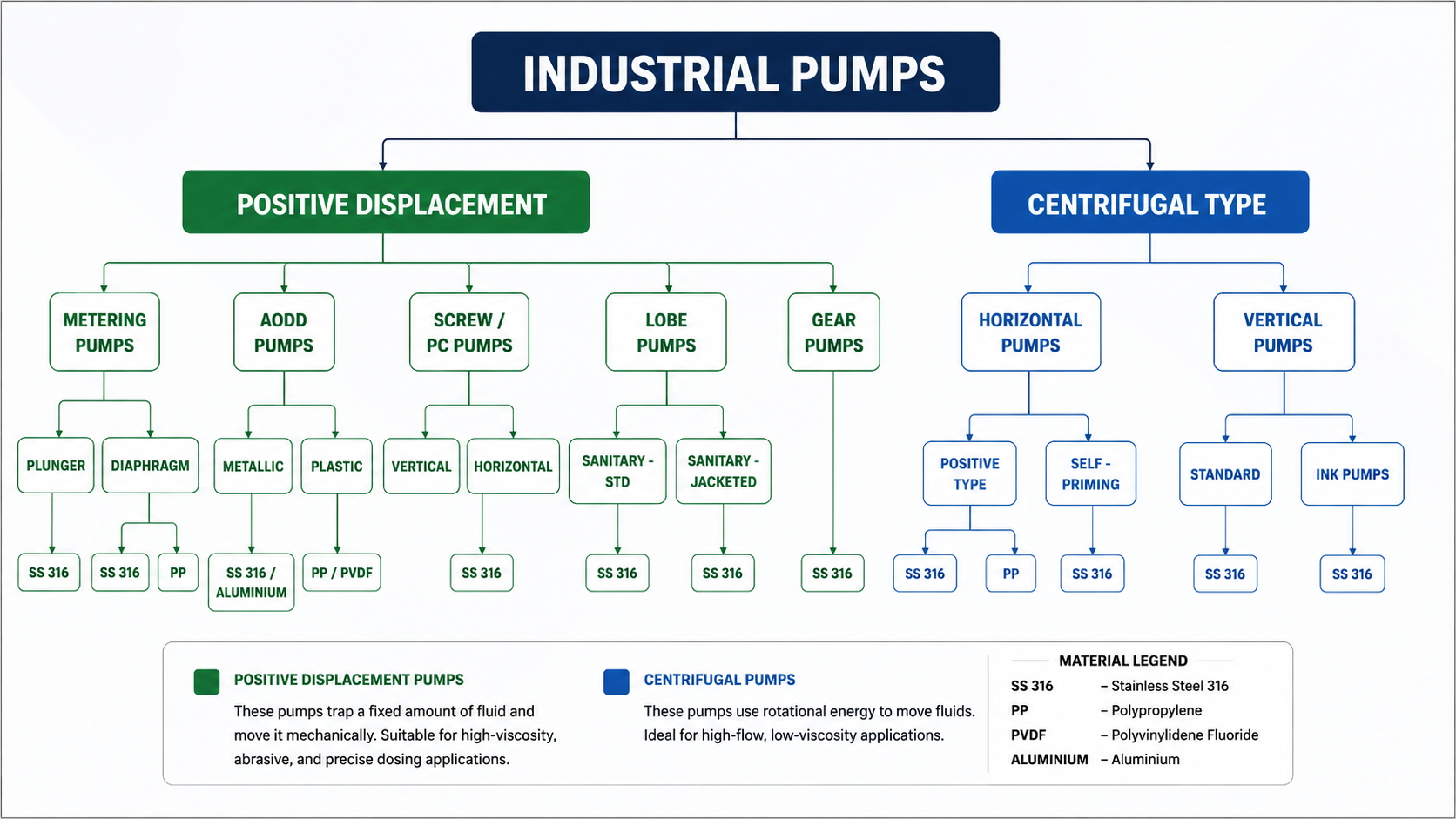
Industrial pumps are broadly divided into two major categories:
Both serve different purposes depending on the nature of the fluid and the application requirements.
Positive displacement pumps work by trapping a fixed amount of fluid and mechanically moving it through the system. Unlike centrifugal systems, these pumps maintain relatively stable flow even when pressure conditions fluctuate.
Because of this, positive displacement pumps are commonly used for viscous fluids, abrasive materials, slurry handling, chemical transfer, and controlled dosing applications. They are widely preferred in industries where consistency and precise transfer conditions matter.
AODD pumps are increasingly used across process industries because of their ability to handle difficult fluids under demanding conditions. They can transfer viscous, abrasive, and corrosive materials while operating efficiently in challenging industrial environments.
Depending on the application, these pumps are available in metallic variants, plastic variants, PP, PVDF, SS 316, and aluminium configurations. AODD pumps are seeing increasing adoption across specialty chemicals, printing, food processing, cosmetics, pharmaceuticals, and lithium battery manufacturing.
Metering pumps are specifically designed for controlled dosing and precision transfer applications where fluid quantity must remain highly accurate. They are commonly used in water treatment, chemical processing, and pharmaceutical industries where operational consistency becomes critical.
Screw pumps are widely used for handling thick and semi-solid materials. These pumps are especially suitable for applications involving sludge, oils, food products, and other high-viscosity fluids where smooth and continuous transfer is important.
Lobe pumps are especially used in hygienic and sanitary applications. Industries such as food processing, cosmetics, dairy, and pharmaceuticals often prefer lobe pumps because they allow gentler fluid handling while maintaining hygienic transfer conditions.
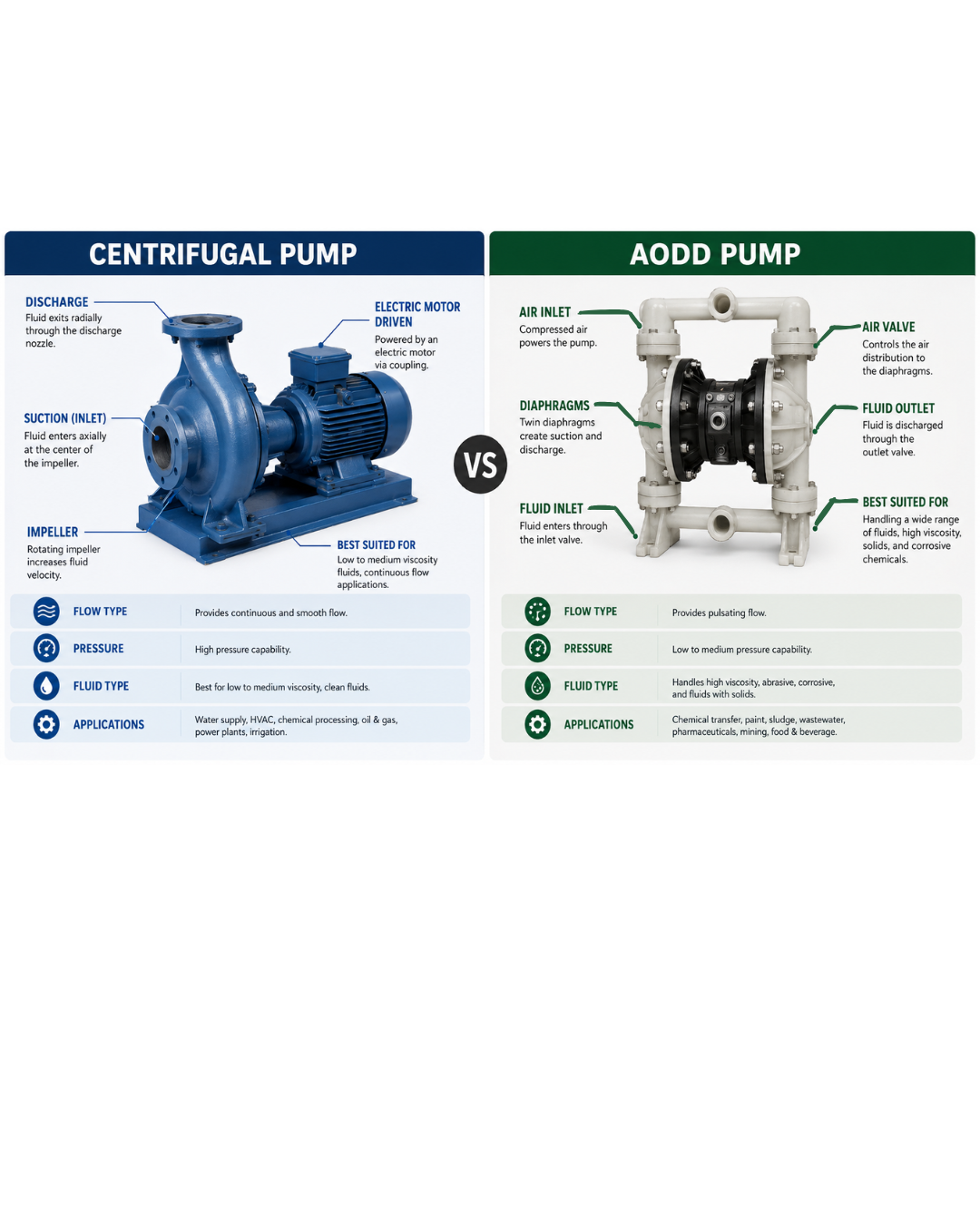
Centrifugal pumps use rotational energy to generate flow. These pumps are generally preferred for high-flow and lower-viscosity applications where large fluid volumes must be transferred efficiently.
Because of their relatively simple design and operational flexibility, centrifugal pumps are widely used across water transfer systems, circulation processes, industrial cooling, utility operations, and wastewater handling.
Horizontal centrifugal pumps are among the most commonly installed industrial pump systems today, available in positive type or self-priming configurations. Depending on chemical compatibility and operating conditions, industries often use SS 316, PP, or other corrosion-resistant materials.
Vertical pumps are typically used in installations where space limitations or tank-based applications make vertical configurations more practical.
Industrial pump selection is no longer just about moving fluid from one place to another. Modern manufacturing environments demand process consistency, operational reliability, and reduced downtime.
Using the wrong pumping system may result in unstable flow, excessive wear, leakage, maintenance issues, and reduced production efficiency. Factors such as viscosity, abrasiveness, temperature, chemical compatibility, and transfer distance all influence pump performance significantly.
As manufacturing industries continue expanding globally, the demand for advanced industrial pumps is also growing rapidly. Industries such as EV battery manufacturing, pharmaceuticals, chemicals, wastewater treatment, food processing, printing, and oil & gas are increasingly focusing on efficient fluid handling systems.
Asia-Pacific currently represents the largest regional market for industrial pumps, accounting for more than 55% of global market share. In India specifically, market studies suggest India's positive displacement pump segment alone could approach nearly USD 790 million within the next decade as industries continue modernizing operations and expanding manufacturing capabilities.
This growth is increasing demand for AODD pumps, air operated pumps, sanitary pumps, chemical transfer pumps, and corrosion-resistant pump systems. Companies involved in industrial fluid handling, including manufacturers like Antlia Engineering Works, are seeing increasing demand across multiple sectors.
Understanding the differences between positive displacement and centrifugal pumps — and knowing which pump type suits which application — is essential for efficient, safe, and reliable industrial operations.
As industries become more automated and production-oriented, pump reliability is becoming directly connected to operational efficiency and long-term cost reduction. Selecting the right industrial pump from the start reduces downtime, minimizes maintenance, and ensures consistent process performance across demanding manufacturing environments.
Our engineers at Antlia Engineering Works, Mumbai will help you identify the right pump type for your specific fluid and application — free consultation.
Get a Free Consultation Call +91 9819395995Industrial pumps are broadly divided into two major categories: Positive Displacement Pumps and Centrifugal Pumps. Both serve different purposes depending on the nature of the fluid and the application requirements.
Positive displacement pumps work by trapping a fixed amount of fluid and mechanically moving it through the system, maintaining stable flow even when pressure fluctuates. Centrifugal pumps use rotational energy to generate flow and are preferred for high-flow, lower-viscosity applications.
Positive displacement pumps — including AODD pumps, screw/progressive cavity pumps, and air operated piston type pumps — are best suited for viscous, abrasive, and high-consistency fluids where stable flow and precision transfer are important.
AODD pumps are used across chemical processing, pharmaceuticals, EV battery manufacturing, wastewater treatment, food processing, cosmetics, specialty chemicals, printing, and lithium battery manufacturing industries.